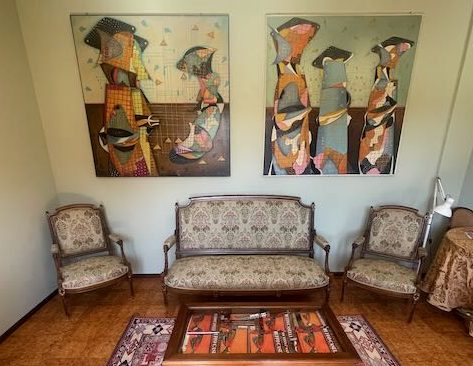

The Center for the Multidisciplinary Study of Cybernetic Existentialism was founded in the early 1980s by Carmen Gallo as a place of study, research, and dialogue dedicated to the work of Ruffo Caselli and to the thought of Cybernetic Existentialism.
Ruffo Caselli (Florence, July 12, 1932 – Ovada, December 2020) was an Italian painter, widely recognized as the founder of Cybernetic Existentialism. He spent most of his working life in Milan, where from the 1960s and 1970s he exhibited in the city’s most important galleries: Il Ponte, Lombardia Arte, Le Firme, Arte d’Oggi.
In Milan he developed a deep friendship and collaboration with Lucio Fontana, the founder of Spatialism. Fontana cut the canvas to reveal space beyond. Caselli worked in the opposite direction: he embedded technological fragments into the canvas to reveal the digital future emerging within human consciousness.

Ruffo Caselli in his studio
Humor and the Absurd as Keys to Reading Caselli
The recent retrospectives of Ruffo Caselli are organized around a single interpretive lens: the philosophy of the absurd. Albert Camus posed one of the twentieth century’s defining existentialist questions in The Myth of Sisyphus, leaving behind the image of Sisyphus pushing his rock up the mountain only to watch it roll back down. Camus argued that those who become aware of the absurd experience a torturous alienation unless they find an outlet for their inner turmoil. For Caselli, the canvas became that outlet. His painting functions as what Camus called absurd creation, a form of revolt against meaninglessness carried out through prophetic vision.
The absurdity in Caselli’s biography is concrete, not metaphorical. He never owned a computer. Yet from the late 1960s onward, he purchased microchips and sewed them by hand onto his canvases, stitching the raw materials of the digital age into oil paint without the machines that gave those components their purpose. His elegant humanoid figures carry circuitry where organs should be, barcodes where skin should be, sensors where eyes should be. He painted the merger of human consciousness and technology decades before artificial intelligence, the internet, or digital culture entered everyday life.
The historical context sharpens the paradox further. By the 1960s, Norbert Wiener had coined the term cybernetics, and artists such as Frieder Nake, Vera Molnár, and Harold Cohen were leaving the studio for the computer lab. Caselli took the opposite path. While his contemporaries required institutional access to massive computers, he worked alone with brush, thread, and silicon: a philosopher of technology who refused the machine itself.
From Leonardo’s House to the Studios of Milan
Ruffo Caselli was born in Florence in 1932, in the same house where Leonardo da Vinci once worked, a connection the artist felt deeply throughout his life. The coincidence carries its own absurdist charge: a child born in the workspace of history’s ultimate Renaissance polymath grows up to become internationally known as the painter of microchips, described by admirers as a da Vinci of modern times.

Costellazione, 1997. Oil on canvas, 80×95 cm. Canvas by Lucio Fontana (1960?) superimposed on a painting by Ruffo Caselli. “…in memory of that difficult journey and of our friendship.”
The Center in the World
From its very beginnings, the Center promoted Caselli’s work in New York – Soho, and later throughout North and South America.
In recent years, Ruffo Caselli’s work has also received great attention in Russia, with exhibitions in major cultural institutions and features in national media.

Exhibition “Behind Every Fact There Is a Shadow” dedicated to Ruffo Caselli, Russia
More recently, Milan honored him with the major retrospective “The Return of Ruffo Caselli to Milan”, a testament to the artist’s profound bond with the city.
Caselli died in December 2020 in Ovada, a small town in northern Italy. He did not live to see the explosion of generative artificial intelligence that has made his six-decade-old paintings feel urgently contemporary. This, too, belongs to the absurdist arc of his story: a genius understood by almost no one in Ovada, while well respected in New York, in Argentina and in Russia, and recognized fully in retrospect, precisely because the future he painted has now arrived.
A Genius Understood in Retrospect
During his lifetime, the depth of Caselli’s thinking remained largely invisible to the broader public. Only the intellectuals and curators who worked closely on his exhibitions grasped the full philosophical architecture behind the paintings. Among those who knew his work, Caselli is considered a remote viewer, one who travels dimensions with the mind.
His paintings have been presented in more than 120 exhibitions across Italy, the United States, South Korea, Dubai, Russia, and South America, building a global audience for a movement that began in near-total obscurity.
The Mission of the Center
Today the Center preserves the historical archive, catalogues, and documentation of Ruffo Caselli’s work.
The body of work studied by the Center includes Caselli’s hand-sewn microchips, his humanoid figures marked with barcodes and integrated circuits, and materials documenting his Milanese years alongside Lucio Fontana.

Carmen Gallo, founder of the Center, with Master Ruffo Caselli

Works by Lucio Fontana and Ruffo Caselli from the Center’s archive
Through exhibitions, publications, and research, the Center presents his paintings not as historical curiosities but as documents of a question the world is only now learning to ask: what remains of the human when the machine moves inside us?
The Center for Multidisciplinary Study of Cybernetic Existentialism preserves the archive of an artist whose life embodies one of modern art’s great paradoxes. Caselli never touched the technology he painted, yet he understood its human consequences more clearly than the engineers who built it. His work stands as evidence that vision does not require the machine, only the courage to face the absurd and answer it with creation.
Media Contact:
Center for Multidisciplinary Study of Cybernetic Existentialism
Press Office
Email: info@cyberneticexistentialism.com
Publications on Cybernetic Existentialism. Please cite with proper source/link.
Cybernetic art and existential thought
Exploring how technology and consciousness intertwine
This blog delves into cybernetic art, a form that merges technological innovation with existential inquiry. Inspired by the works of Ruffo Caselli and cybernetic philosophy, it examines how machines and humans co-create meaning in a digital age. Through artistic expression and critical analysis, we explore the boundaries of consciousness, identity, and the role of technology as an extension of human experience.


